About the Summit & Call for Proposals

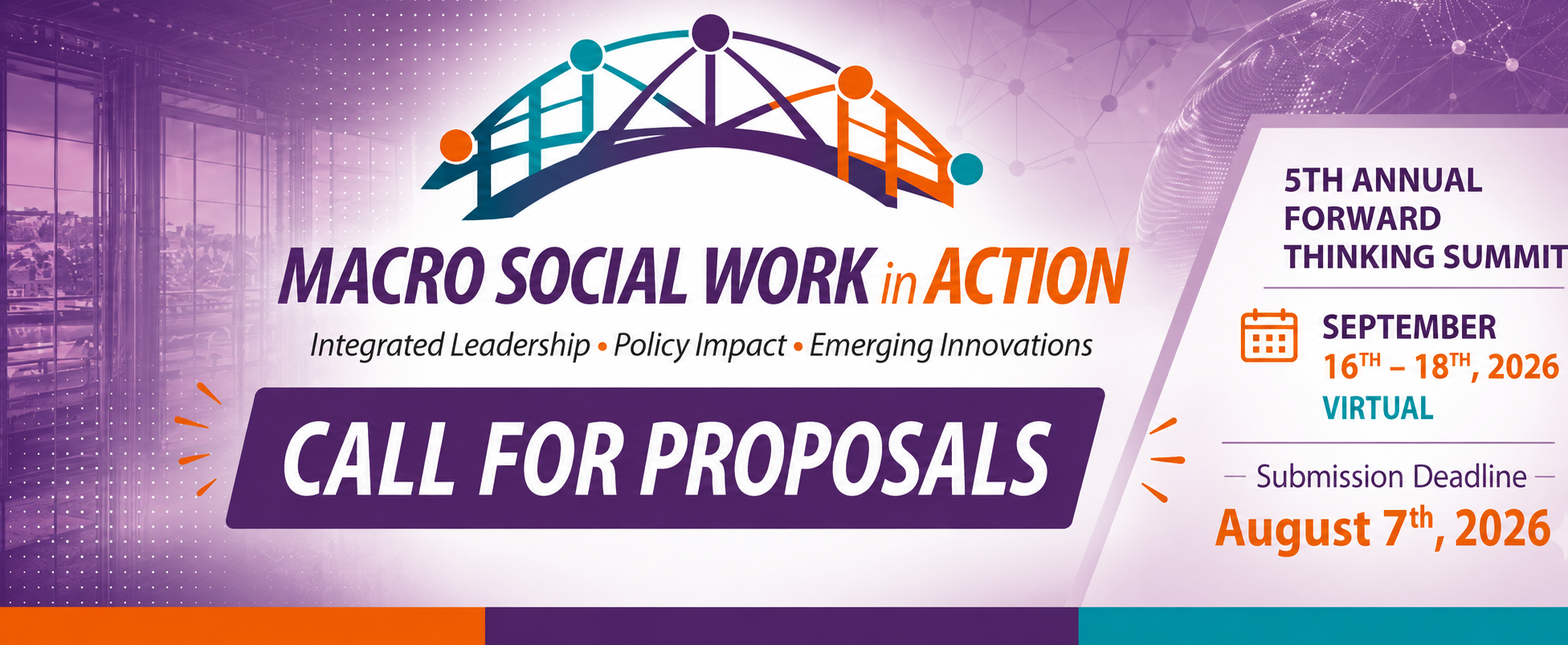
The Network for Social Work Management (NSWM) invites scholars, practitioners, educators, advocates, and organizational leaders to submit proposals for the 5th Forward Thinking Summit to be held virtually September 16th – 18th, 2026.

This year's theme, Macro Social Work in Action: Integrated Leadership, Policy Impact, and Emerging Innovations, calls for presentations that bridge theory and practice, challenge prevailing assumptions, and offer actionable insights for social work managers and leaders working at the intersection of organizations, communities, and systems.

The Forward-Thinking Summit is NSWM's premier annual convening. The Call for Proposals reflects our commitment to inclusive, rigorous, and forward-looking scholarship and practice. We welcome submissions from a wide range of methodological traditions, practice contexts, and geographic perspectives — including international submissions.

Summit DatesSeptember 16th – 18th, 2026
FormatVirtual — Live Streaming, Synchronous Sessions, Interactive Breakouts
Submission PortalSubmit Here
Submission DeadlineJuly 31st, 2026
Notification of AcceptanceAugust 15th, 2026
Presenter Registration DeadlineAugust 31st, 2026
Questions[email protected]

Summit Theme & Thematic Pillars

All submissions should engage meaningfully with the summit theme and should connect to at least one of the three thematic pillars and their associated sub-themes. Proposals that speak to multiple pillars or sub-themes are particularly encouraged.

SystemsLeading at the Nexus

Cross-sector leadership at the intersection of government, nonprofit, philanthropy, business, and community — building coalitions and aligning resources across sectors that don’t naturally speak the same language.

LegacyThe Wisdom Factor

Intergenerational knowledge succession and mentorship — intentionally transferring institutional wisdom and building shared leadership cultures that bridge generational divides.

WellbeingRadical Presence

Healing-centered, trauma-informed organizational leadership — building workplaces that prioritize wellbeing, reduce secondary trauma, and cultivate cultures of care.

TechnologyAI-Augmented Leadership

Critical engagement with artificial intelligence as an organizational tool and policy challenge — centering human dignity, professional judgment, and equity in algorithmic decision-making.

EquityThe Decolonized Organization

Reimagining organizational structures, governance models, and accountability frameworks to disrupt colonial power dynamics and build organizations where communities hold genuine power.

AdvocacyThe New Advocacy Playbook

Narrative strategy, digital organizing, unlikely alliances, and rapid-response policy engagement for a fragmented and polarized political landscape.

EvidenceData as Power

Building data cultures, research-practice-policy partnerships, and evidence translation capacities that use both quantitative data and community narratives to drive policy change at scale.

JusticeDecolonizing Policy

Indigenous knowledge systems, Global South frameworks, and community-defined definitions of flourishing as the basis for transformative, anti-colonial policy advocacy.

SystemsThe Politics of Care

Strategic navigation of the restructuring social welfare state — understanding political forces, protecting communities, and identifying opportunities for more just and sustainable care systems.

AccountabilityThe Equity Audit

Systematic tools for assessing whether programs, policies, and organizations are producing more equitable outcomes — moving from equity statements to equity accountability.

TechnologyThe Social Work Tech Stack

Critical evaluation and strategic deployment of AI, data analytics, telehealth, mobile platforms, and integrated data systems — with equity and client dignity at the center.

EnterpriseMission-Driven Entrepreneurship

Social work entrepreneurship — nonprofits, social enterprises, consulting practices, and technology ventures that deploy the profession’s values in new and sustainable ways.

EquityDigital Equity by Design

Intentional design for digital inclusion — ensuring technology expands rather than restricts access to services, rights, and opportunity for underserved communities.

AnalyticsThe Intelligent Agency

Data dashboards, outcome analytics, and predictive modeling used not to surveil or control but to continuously learn, improve, and advocate for communities.

WorkforceThe Future of Social Work

Leadership for hybrid, remote, and AI-augmented social work workplaces — building organizations that meet the expectations of the next generation while serving clients effectively.

Specialized Conferences & Intensive Tracks

In addition to the core pillars, the Summit features two specialized leadership tracks. Proposals submitted under these areas will be evaluated for inclusion in the specific track and its associated Certificate of Completion.

Health Leadership Track

Systems Pathway & Certificate Eligible

Sessions in this track should align with one or more of the conference’s three pillars while focusing specifically on leadership in health, behavioral health, aging, palliative care, integrated care, community-based care, or related human service systems.

Focus Context: Strong proposals will address the leadership knowledge and skills social workers need to influence health systems, strengthen programs, improve care coordination, advance health equity, respond to social determinants of health, use data and technology effectively, build interdisciplinary partnerships, and lead organizational or systems-level change.

Requirement for Certificate: Presenters interested in certificate inclusion should clearly explain how their session supports applied leadership development and provides participants with practical tools, frameworks, strategies, or examples that can be used in health-related practice, management, education, or policy settings.

Technology/AI Leadership Track

Innovation Pathway & Certificate Eligible

Sessions in this track should align with one or more of the conference’s three pillars (Integrated Leadership, Policy Impact, and Emerging Innovations) while focusing on the leadership, management, ethical, organizational, and policy implications of artificial intelligence, digital tools, data systems, and emerging technologies in social work and human services.

Focus Context: Strong proposals will address the knowledge and skills social work leaders need to evaluate, implement, manage, and ethically use technology in organizational settings. Topics may include AI literacy, ethical AI use, data-informed decision-making, digital equity, privacy and confidentiality, cybersecurity, technology adoption, workforce development, virtual service delivery, program evaluation, automation, or the impact of emerging technologies.

Requirement for Certificate: Presenters interested in certificate inclusion should clearly explain how their session supports applied leadership development and provides participants with practical tools, frameworks, strategies, examples, or safeguards that can be used in social work management, education, policy, practice, or organizational leadership settings.

Submission Categories

The Summit welcomes proposals across five presentation formats. Submitters should select the format that best matches their content and objectives. All formats are delivered in the virtual environment.
W
Interactive Workshops — 60 minutes

Interactive, skill-building sessions grounded in real-world application. Workshops should include active learning components, practical tools participants can apply immediately, and opportunities for participant engagement.

P
Practice Innovations — 30 minutes

Sessions grounded in real-world applications that include practical skills or systems participants can apply immediately. These sessions differ from workshops in that they are not expected to be interactive.

R
Research Presentations — 30 minutes

Presentations on research regarding changes in macro social work that can inform participants on trends and changes, or what to expect in the coming future. Presentations should include ideas for how the research may be applicable to practitioners outside of academia.

S
Student Poster Presentations — 30 Minutes

Visual displays of research, program evaluations, practice innovations, or conceptual frameworks. Posters are hosted in the virtual summit environment for the duration of the conference and include an asynchronous poster sharing web-page within Whova.

M
Marketplace Presentations — 30 Minutes

Designed for sponsors and partners who wish to promote products or services that benefit executives and leaders, such as books, coaching, software, or training programs. Marketplace sessions are available for $750, in addition to regular registration. An expanded bundle is available for $1,150 (includes a full registration and a 90-minute lab demo). Early bird rates of $650 and $1,050 respectively are available through July 31.

Submission Requirements

All proposals must be submitted through the NSWM submission portal here. Submissions sent by email will not be reviewed. The portal accepts proposals in Microsoft Word format.

Required Components

All proposals must include the following components regardless of format:

  • Presenter Information: Full name, credentials, title, biography (max 150 words per person) organization, and contact information for all presenters (maximum 5 presenters per submission)
    John Doe
    Bio

    Jane Addams
    Bio
  • Presentation Format: Selection of one of the five submission categories listed above.
  • Thematic Alignment: Identification of the conference pillars: Integrated Leadership, Policy Impact and Emerging Innovations.
  • Title: A concise, engaging title (15 words maximum).
  • Abstract: A plain-language abstract for the program guide (50 words maximum).
  • Proposal: A detailed description of the presentation (500 words maximum).
  • Learning Objectives: Minimum of three specific and measurable learning objectives.
  • Category of CEU: For the purpose of tracking CEU type being offered.

Proposal Format Requirements

FormatExtended Description Requirements
Workshops500 words covering: session structure and timeline, active learning methods, interactive engagement components, materials/tools to be shared, and facilitator qualifications.
Practice Innovations500 words covering: the specific tool, system, or management strategy implemented, real-world application contexts, and direct takeaways for practitioners.
Research500 words covering: theoretical framework, methodology, findings/results, implications for practice/policy, and future directions outside academia.
Student Posters400–500 words covering: project background and purpose, methodology or analytical framework, key findings/innovations, and direct implications for macro practice.
Marketplace300–400 words covering: the product, training, or software tool description, its relevance to human services executives, and a high-level outline of the solution demonstration.

Review Process & Criteria

All proposals undergo double-blind peer review by a panel of social work scholars, practitioners, and organizational leaders with expertise in the relevant thematic area. Proposals are evaluated on five criteria. Submitters should ensure their proposals address each criterion explicitly.

The Program Committee reserves the right to suggest an alternative format for accepted proposals (e.g., converting an Interactive Workshop to a Practice Innovations session) based on thematic clustering and program balance. Submitters will be notified and invited to confirm or withdraw.

Priority will be given to proposals that:

  • Represent diverse methodological traditions.
  • Include practitioner-researcher collaboration.
  • Reflect international or cross-cultural perspectives.
  • Center the voices and experiences of communities served by social work organizations.
  • Emphasize real-world applications.
  • Explicitly address equity, diversity, and inclusion.
Review CriteriaWeight
Thematic Alignment — Clear connection to the summit theme and at least one pillar/sub-theme25%
Scholarly or Practice Rigor — Evidence of methodological quality, theoretical grounding, or practice depth25%
Relevance & Impact — Significance for social work management, leadership, or policy practice20%
Innovativeness — Originality of ideas, approaches, or findings; forward-thinking orientation20%
Presentation Quality — Clarity of writing, well-defined objectives, and feasibility of proposed format10%

Presenter Expectations & Policies

Registration Requirement

Acceptance of a proposal constitutes a commitment to register for the Summit and present as scheduled. All presenters (including co-presenters) must register by August 31st, 2026. Proposals from individuals who do not register by this date may be withdrawn from the program. Registration is $250. Research presentation registration requirements may be waived on a case-by-case basis.

Virtual Participation Requirements

  • Reliable internet connection capable of supporting video conferencing.
  • Access to Zoom or the designated virtual conferencing platform.
  • Slide presentations submitted in PDF format at least 5 business days prior to the Summit.
  • Availability for a 30-minute technical orientation session prior to the Summit.
  • Attendance for the full duration of the scheduled session, including Q&A.

Accessibility Standards

NSWM is committed to accessible programming. All presenters are required to:

  • Use slide templates with sufficient color contrast and readable font sizes (minimum 24pt).
  • Provide alt-text descriptions for all images, charts, and visual content.
  • Submit a transcript or detailed outline for asynchronous poster presentations.
  • Indicate any accessibility needs at the time of registration.

Publication & Recording Policy

With presenter consent, all Summit sessions will be recorded and made available to registered participants for 60 days following the event. Presenters who do not wish to be recorded must notify NSWM at the time of submission. Accepted proposals may be invited to submit manuscripts for consideration in the NSWM Journal of Social Work Management.

Key Dates & Timeline

DateMilestone
May 15th, 2026Call for Papers opens; submission portal goes live
June 1st, 2026Early submission encouraged (rolling notifications begin)
July 31st, 2026Submission deadline — no extensions will be granted
August 1st – 14th, 2026Blind peer review period
August 18th, 2026Notification of acceptance, or non-acceptance. Slide templates distributed.
August 31st, 2026Presenter confirmations due
August 31st, 2026Presenter registration deadline
September 9th, 2026Final slides due (PDF)
September 16-18, 20265th Forward Thinking Summit — Virtual

Frequently Asked Questions

Yes. Individuals may submit up to two proposals as lead presenter. There is no limit on the number of proposals on which an individual may appear as co-presenter.

Absolutely. NSWM strongly encourages proposals from doctoral students, MSW students, and early-career professionals. Student submissions are reviewed using the same criteria as all other submissions. Student presenters are eligible for reduced registration rates.

Yes. NSWM welcomes submissions from social work practitioners, educators, and researchers worldwide. International perspectives are a priority for the program. The Summit will be conducted in English; proposers who wish to present in another language should contact [email protected] to discuss options.

The July 31st, 2026, deadline is firm. Submissions received after this date will not be considered for the 2026 Summit.

Presenters may note scheduling constraints (e.g., time zone) in the submission portal, and the Program Committee will make reasonable accommodations. However, specific day or time requests cannot be guaranteed.

Submit Your Proposal Now

Deadline: July 31, 2026 | [email protected]